

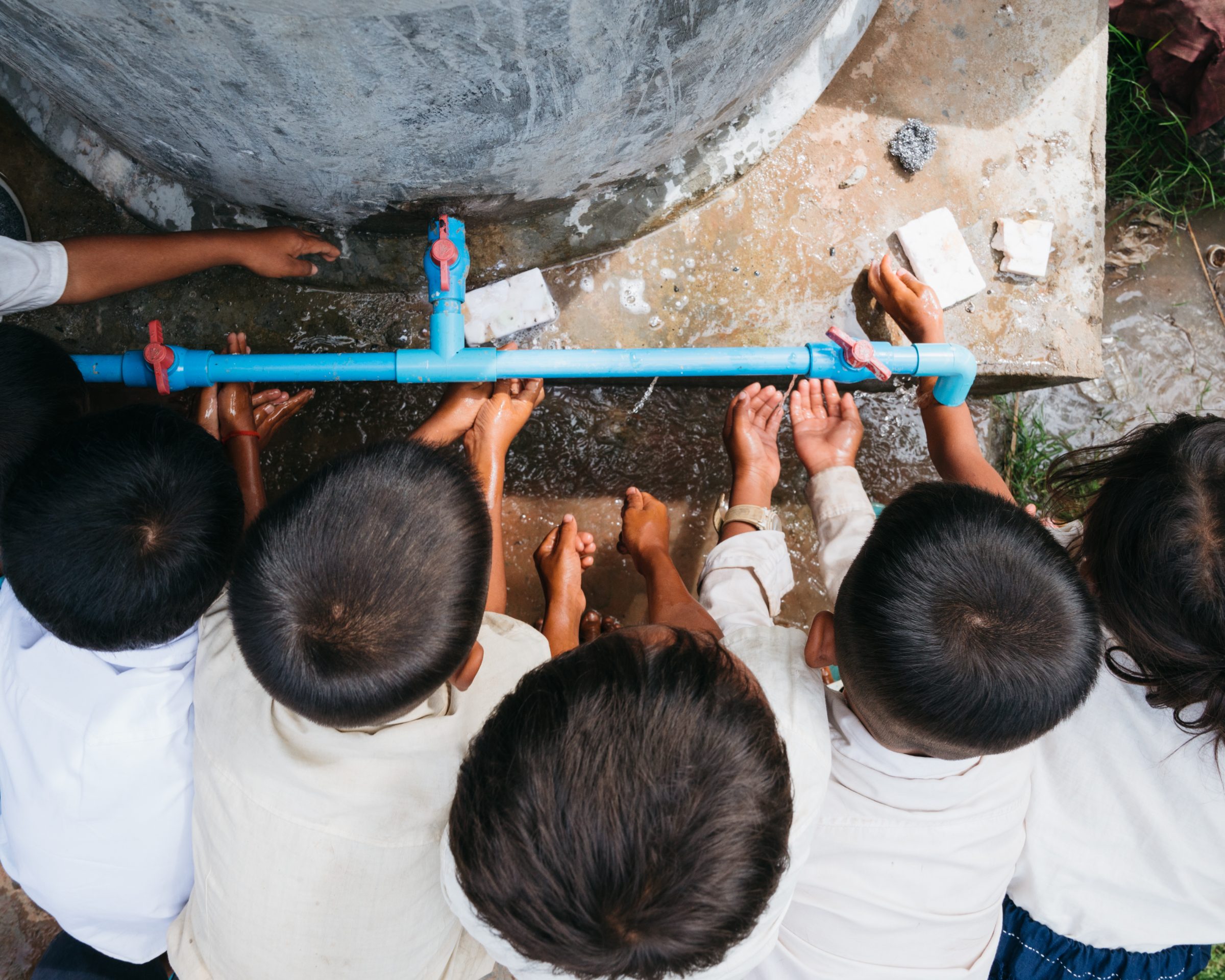
Why handwashing with soap matters
Throughout the least developed countries, the burden of (highly) preventable illnesses continue to cause death and irreparable damage to the life and development of young children. Handwashing with soap (HWWS) remains the most cost-effective method to prevent hygiene-related illnesses and deaths. This simple practice removes 92% of harmful germs and has been linked to important reductions in a range of deadly and debilitating diseases.
Due to the immense lifesaving impact, significant effort has been devoted to uncover new ways to improve handwashing promotion efforts. And there is now a growing body of evidence suggesting that a key solution can be found within the subconscious realm of nudges and incentivizing cues. The introduction of “nudges” (environmental cues for handwashing) has been a highly useful addition to handwashing promotion. When children are targeted, tools that evoke notions of play and curiosity are proving to be especially potent drivers of change.

Introducing: SOAPLAY™
Building on these revolutionary insights, Eco-Soap Bank has launched a new nudge soap bar for children. SOAPLAY — recycled soap bars made in a variety of fun shapes and colors — is designed to tap into the sense of curiosity and play that has been shown to constitute key cognitive elements of childhood realities. Backed by findings from the field of nudge theory, these child-friendly soap bars can serve as important environmental cues for HWWS among children.
The study
To test the hypothesis, Eco-Soap Bank conducted two pilot studies — one in household settings and one in school settings — as well as a full-scale school test in rural Tanzania. The full-scale test, conducted in partnership with World Vision, included 16,000 children attending 18 primary schools in the Dabalo and Mpwayungu provinces. All tests were simple A/B pre-posttest randomized control designs comparing the effects of regularly shaped soap bars to SOAPLAY bars. Participants were randomly sampled and assigned to a control group (receiving regular soap) or an intervention group (receiving SOAPLAY). To generate a valid comparison, all participants received the same hygiene intervention — a short standard hygiene session followed by soap distributions — with the only exception being that one group received regular soap bars and one group SOAPLAY bars. All groups were assessed both before the intervention (baseline) and a few weeks after the intervention (endline).
The test results offer new insight into the drivers of handwashing with soap among children. Across all tests, SOAPLAY was by far the preferred soap option for handwashing. A vast majority expressed a clear preference for using SOAPLAY and rated the soap as better than other soap bars they used in the past. A large proportion of children also reported that the use of SOAPLAY had made handwashing feel more fun and inspired them to talk more about handwashing with their family and friends. The preference for using SOAPLAY was also reflected in the realm of handwashing practices.
- Children given SOAPLAY were 3.78× more likely (95% CI [3.4, 4.1], p < 0.001) to wash their hands with soap at endline compared to baseline
- 7% more likely (RR 95% CI [1.04, 1.09], p < 0.001) to wash their hands with soap after using the toilet, compared to children given a regular soap bar
- Used 72% more soap during the test period than children given regular shaped soap — supporting a higher overall handwashing rate in SOAPLAY schools
- 2.3× more likely (95% CI [2.1, 2.5]) to have soap for handwashing at home after the intervention — children actively carried hygiene routines from school into the home
- School absence due to illness in the two weeks preceding the survey decreased by 35%
- Diarrhea cases and other general illness symptoms declined by 43% across both groups
- Children given SOAPLAY were 2.4× more likely (p = 0.008) to have washed their hands 3+ times the day before, compared to children given regular soap
- Overall handwashing score improved 20% (p < 0.001, ds = 0.844) with SOAPLAY vs 11% (p = 0.255) with regular bars
- 64% washed hands with soap at two or more key moments the day before, vs 37% in the control group (p = 0.006, V = 0.337)
- Regular handwashing at key moments improved 11% after using the toilet (p = 0.001) and 15% before eating (p = 0.08), while the control group decreased slightly
- Children washing hands 4+ times a day rose from 8% to 37% (p < 0.001) with SOAPLAY, vs 11% to 22% (p = 0.29) in the control group — at endline, 1.72× more likely (p = 0.07)
- Overall handwashing score improved an average of 34% with SOAPLAY at home, vs 24% in the control group
- 1.75× more likely (p = 0.19) to have wet soap at home during endline observations — indicating regular use

Why this matters
The findings provide compelling evidence supporting the notion that modified soap bars can help influence and instill positive handwashing practices among children. In a world of continued hygiene paucities, all such gains are of utmost importance. To this end, SOAPLAY offers a highly affordable, incentivizing soap bar alternative ready for large-scale distribution to vulnerable communities of children around the world. Either as part of a larger nudge-based handwashing package or on its own, SOAPLAY can add an important new dimension to handwashing promotion for children. With the aid of affordable and attractive soap bars, it is now possible to help more children engage with handwashing on a level that moves beyond the abstract notions of germs and illnesses and tap into the powerful realm of play in a way that subconsciously nudges them toward improved handwashing practices.
// The Eco-Soap Bank Team, in collaboration with World Vision
For the full research paper and more, see our research page.
.png)
